
Home → Blog → Clearance Testing in Mold Remediation: Texas Guide
Clearance Testing in Mold Remediation: Texas Guide
May 23, 2026
Clearance Testing in Mold Remediation: Texas Guide
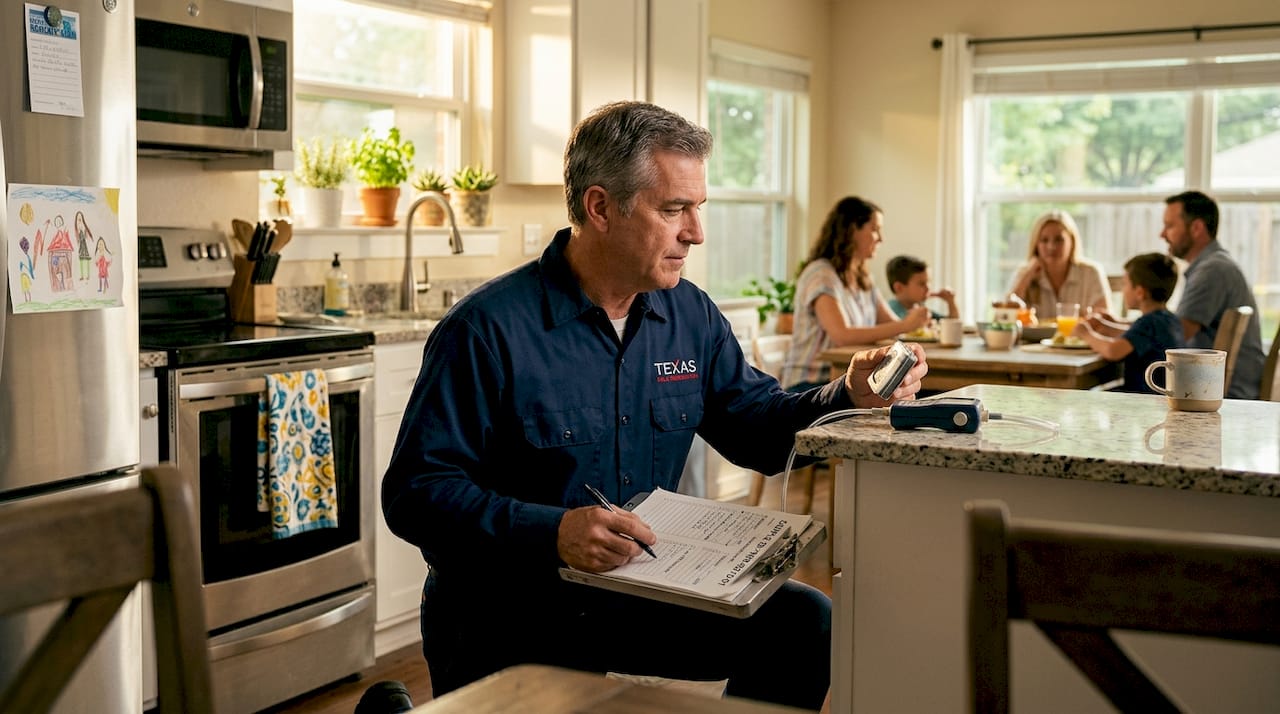
You had the mold removed. The crew packed up, the containment came down, and the area looks clean. So you’re safe now, right? Not necessarily. What is clearance testing in mold remediation is one of the most searched questions Texas homeowners ask after a cleanup job, and the answer matters more than most people realize. Visible mold removal does not guarantee safe air. Clearance testing is the scientific step that actually confirms your home is ready to occupy, and skipping it is a gamble with your health and your property.
Table of Contents
- Key Takeaways
- What is mold remediation clearance testing and why it matters
- Clearance testing procedures: what to expect step-by-step
- Interpreting results and what to do if your home fails
- Cost factors and typical pricing in Texas
- How clearance testing fits into the full remediation process
- My take on why clearance testing is non-negotiable
- Find licensed Texas mold professionals near you
- FAQ
Key Takeaways
| Point | Details |
|---|---|
| Clearance testing verifies safety | It confirms indoor mold levels match safe outdoor background levels after remediation. |
| Testing happens before reconstruction | Clearance testing must occur before containment removal to prevent spreading spores to new materials. |
| Pass or fail has real consequences | A failing result means the contractor must re-clean and you must retest before moving back in. |
| Independent inspectors matter | Hire a tester with no financial stake in the remediation to get unbiased, defensible results. |
| Documentation protects you | Clearance reports support insurance claims, home sale disclosures, and tenant rights disputes in Texas. |
What is mold remediation clearance testing and why it matters
Clearance testing, also called Post-Remediation Verification (PRV), is the final quality-control step in the mold remediation process. It answers one specific question: did the cleanup actually work? Rather than relying on a visual check alone, clearance testing uses air sampling, surface sampling, and lab analysis to confirm that mold spore levels inside your home have returned to normal background levels comparable to the outdoor air around your property.
What is mold remediation, at its core? It is the controlled removal, containment, and treatment of mold-contaminated materials in a building. But removal is only part of the story. Mold spores are microscopic. You cannot see them floating in the air. A room can look spotless and still have spore concentrations high enough to cause respiratory problems, especially for children, the elderly, or anyone with asthma.
Here is why the importance of clearance testing cannot be overstated:
- Mold spores become airborne during cleanup, even with proper containment in place.
- Some mold species are toxigenic and harmful at low concentrations.
- Moisture problems that caused the mold may not be fully resolved, creating conditions for regrowth.
- Without testing, there is no documented proof that your home is safe.
Clearance testing is the only reliable way to verify remediation success and prevent costly mold regrowth from unresolved moisture. That is not an opinion. It is the standard that licensed mold professionals in Texas operate under.
Pro Tip: In Texas, a licensed mold remediation contractor must provide a Certificate of Mold Damage Remediation upon project completion. Clearance testing results are often required to support that certificate. Ask your contractor about this before work begins.
Clearance testing procedures: what to expect step-by-step
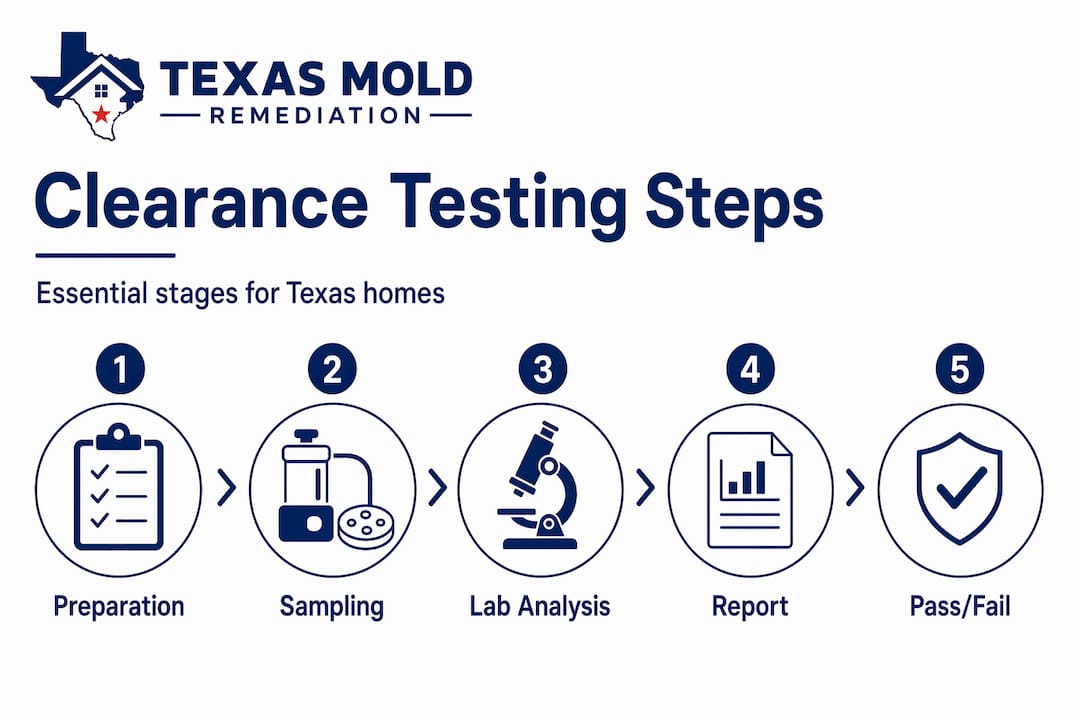
Knowing what happens during clearance testing removes the guesswork and helps you hold your inspector accountable. The standard clearance testing protocol includes visual inspection, active air sampling, surface sampling, and lab analysis compared to outdoor baseline levels. Here is how the process typically unfolds:
-
Visual inspection with containment still in place. The inspector walks the remediated area thoroughly before any barriers come down. They look for visible mold growth, moisture staining, and signs of incomplete cleanup. This step catches obvious failures before a single sample is collected.
-
Outdoor control samples are collected. The inspector takes air samples from outside your home. These become the baseline. Your indoor results will be compared against this outdoor reading to determine whether indoor levels are elevated.
-
Active air sampling indoors. Using a calibrated pump and spore trap cassettes, the inspector collects air samples from the remediated area and from unaffected rooms. Fans are sometimes used to dislodge spores that may have settled on surfaces, giving a more accurate picture of what is actually in the air.
-
Surface sampling from suspect areas. Swabs or tape lifts are taken from surfaces where mold was found or treated. This confirms whether mold colonies remain on materials that were cleaned rather than removed.
-
Samples are sent to an accredited laboratory. The lab identifies mold species and counts spore concentrations. This is not a quick turnaround. Results typically take one to three business days.
-
The inspector compares indoor results to outdoor and unaffected indoor air. If indoor spore counts are similar to or lower than outdoor levels, and no toxigenic species are present, the space passes. If counts are elevated or harmful species appear, it fails.
Pro Tip: Ask your inspector whether they use an accredited laboratory. An accredited lab produces defensible results that hold up for insurance claims and real estate disclosures. A cheap test with an unaccredited lab may not be worth the paper it is printed on.
The timing of this entire process matters enormously. Clearance testing must happen before containment barriers are removed and before any reconstruction begins. Testing after the plastic sheeting comes down defeats the purpose entirely.
Interpreting results and what to do if your home fails
Getting your clearance report back is one thing. Understanding what it means is another. The good news is that the pass or fail determination is relatively straightforward once you know what to look for.
What a passing result looks like: Indoor spore counts are comparable to outdoor air. No toxigenic mold species are detected in the remediated area. The inspector confirms that moisture readings are within normal range. Your home is cleared for reconstruction and reoccupancy.
What a failing result means: Lab results showing elevated spore counts or toxigenic mold species indicate the space is not yet safe. The remediation contractor must return, re-clean the affected areas, and the testing process starts over. This continues until the space passes.
Here is what you need to know about next steps after a failed test:
- Do not allow containment to be removed until a passing result is confirmed.
- The re-cleaning cost is typically the contractor’s responsibility if the original scope of work was not completed properly.
- Document every failed test result. This paper trail protects you if disputes arise.
- If the same area fails multiple times, consider whether the underlying moisture source was ever properly repaired.
A clearance report is more than a pass or fail slip. It is a legal document. In Texas, it can support insurance claims, satisfy real estate disclosure requirements, and serve as evidence in tenant disputes with landlords. Keep every copy.
Detailed clearance reports provide evidence of remediation success that is critical for health, insurance, and real estate purposes. If you are selling your home or renting a property, that documentation is not optional. It is protection.
Cost factors and typical pricing in Texas
Clearance testing is not free, but it is far less expensive than the alternative. Here is what you can realistically expect to pay in Texas.
| Service type | Typical price range | What is included |
|---|---|---|
| Visual inspection only | $150 to $300 | Walk-through, no samples collected |
| Standard clearance testing | $200 to $400 | Air and surface sampling, lab analysis |
| Comprehensive testing | $400 to $650 | Air, surface, moisture mapping, HVAC sampling |
Professional mold clearance testing typically costs between $200 and $400, with property size and complexity affecting the final price. A small bathroom remediation costs less to test than a whole-house flood remediation involving multiple rooms and an HVAC system.
Several factors push costs higher in Texas specifically. The state’s humidity and heat create conditions where mold spreads faster and more broadly, meaning larger remediated areas require more samples. Properties in coastal counties like Orange County or high-humidity areas near Houston can involve more complex testing scenarios.
The most important cost consideration is independence. Good professionals provide clear, itemized quotes and do not have conflicts of interest from performing the remediation themselves. Never hire the same company to both remediate and perform clearance testing. That is like asking a contractor to grade their own work.
Pro Tip: If a company offers clearance testing for under $100 or bundles it free with remediation, that is a red flag. Legitimate lab analysis alone costs more than that. Cheap testing often skips lab work entirely or uses unaccredited facilities whose results carry no weight.
You can find licensed mold contractors in Lee County and across Texas through Txmoldremediation, which lists only TDLR-licensed professionals to help you avoid exactly these kinds of cost traps.
How clearance testing fits into the full remediation process
Understanding where clearance testing sits in the mold remediation process helps you manage the entire project, not just one piece of it. The sequence matters, and deviating from it creates real problems.
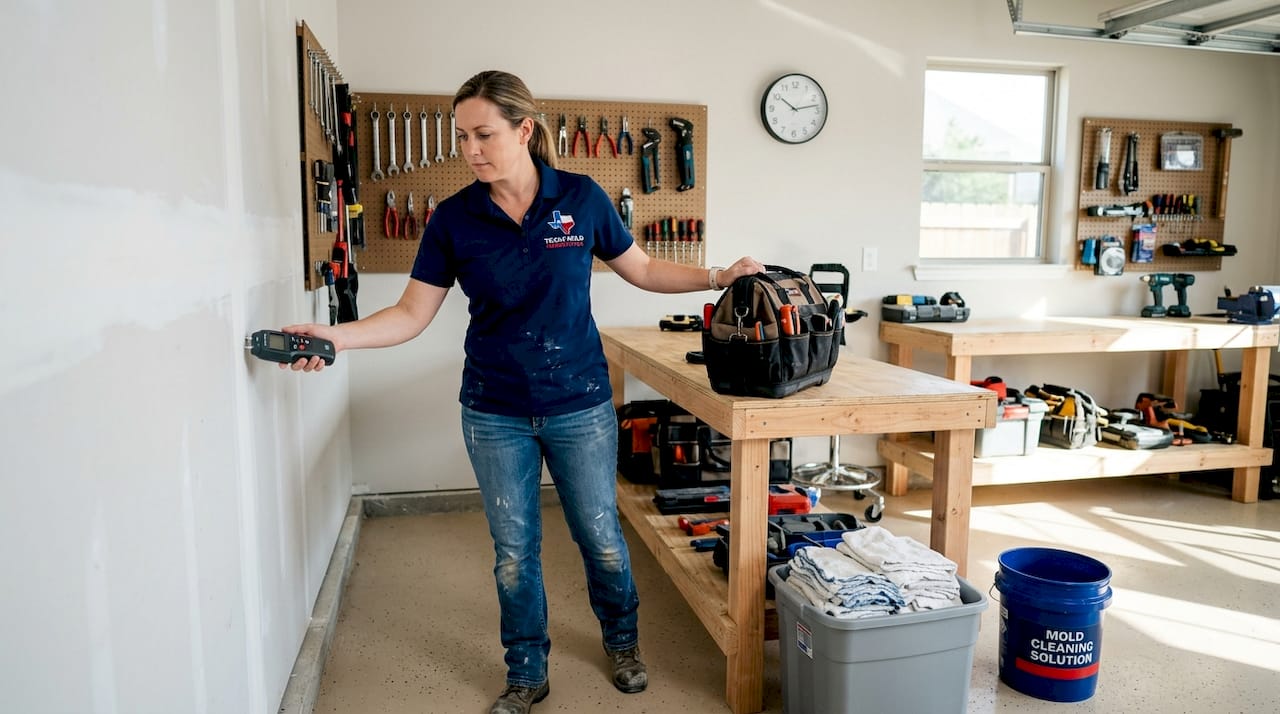
The proper order looks like this: initial mold inspection and moisture assessment, followed by remediation with proper containment and negative air pressure, then clearance testing before containment removal, and finally reconstruction and reoccupancy. Every step depends on the one before it.
Here is what goes wrong when clearance testing is skipped or done out of order:
- Spores from a contaminated remediated area spread into clean areas when containment comes down too early.
- New drywall and insulation installed before testing passes can become contaminated immediately, requiring a second round of demolition and remediation.
- Skipping clearance testing often results in mold regrowth due to unresolved moisture issues or improper containment that was never verified.
- Homeowners and tenants move back in without knowing whether the air is safe.
- Insurance companies may deny future claims if they determine that proper post-remediation verification was never performed.
A thorough clearance inspection confirms that moisture problems are resolved, not just that visible mold is gone. This is the piece most people miss. Mold is a symptom. Moisture is the disease. Clearance testing checks for both.
For Texas homeowners dealing with water intrusion from storms, plumbing failures, or HVAC condensation issues, this moisture verification step is especially critical. The state’s climate means that any residual moisture left after remediation will almost certainly produce new mold growth within weeks.
You can search for licensed contractors in Harris County or any of Texas’s 254 counties through Txmoldremediation to find professionals who follow this full workflow correctly.
My take on why clearance testing is non-negotiable
I have spent years reviewing mold remediation cases across Texas, and the pattern I see most often is this: homeowners trust the visual. The crew cleans up, the area looks dry and white, and everyone assumes the job is done. Then three months later, someone in the household starts having respiratory problems, or a home inspector finds active mold growth behind the new drywall that was installed over an area that was never properly cleared.
What I have learned is that clearance testing is not a formality. It is the only moment in the entire mold remediation process where an independent third party actually verifies that the work was done right. Every other step relies on the contractor’s word.
The cases that go badly are almost always the ones where the homeowner either skipped testing to save a few hundred dollars or let the remediation company perform their own clearance check. Neither approach gives you an honest result. The inspector has to be independent, period.
My advice to any Texas homeowner or tenant: do not move back in until you have a written clearance report from a licensed, independent inspector. Do not let the contractor rush you. And do not assume that because the area looks clean, it is clean. The mold you cannot see is the mold that will make you sick.
— Tucker
Find licensed Texas mold professionals near you
Clearance testing is only as good as the team performing the remediation that precedes it. If the cleanup was done poorly, no amount of testing will fix it. It will just reveal the failure. That is why choosing a licensed, TDLR-verified contractor from the start is the most important decision you make.
Txmoldremediation is a free public resource covering all 254 Texas counties. Every contractor listed holds a current, active TDLR license, verified weekly from state records. Whether you are in Montgomery County dealing with post-flood mold or anywhere else in the state, you can find a qualified local professional who knows how to perform the full remediation and clearance testing workflow correctly. Start your search at Txmoldremediation and hire with confidence.
FAQ
What is clearance testing in mold remediation?
Clearance testing, also called Post-Remediation Verification, is the process of collecting air and surface samples after mold remediation to confirm that indoor mold levels have returned to safe background levels comparable to outdoor air.
When should clearance testing happen?
Clearance testing must be completed before containment barriers are removed and before any reconstruction begins. Testing after containment is removed risks spreading spores to clean areas and contaminating new building materials.
What happens if my home fails clearance testing?
A failed clearance test means the remediation contractor must re-clean the affected areas and testing must be repeated. You should not allow reconstruction or reoccupancy until the space receives a passing result.
How much does mold clearance testing cost in Texas?
Standard clearance testing with air and surface sampling typically costs between $200 and $400. Comprehensive testing that includes moisture mapping and HVAC sampling can range from $400 to $650 depending on property size and complexity.
Do I need a mold clearance certificate in Texas?
In Texas, a licensed mold remediation contractor is required to provide a Certificate of Mold Damage Remediation upon project completion. Clearance testing results support this certificate and are critical for insurance claims, home sale disclosures, and tenant rights documentation.
Recommended
Find a Licensed Mold Contractor in Your Area
Search by city to find TDLR-verified mold remediation contractors near you — or call for a free consultation.